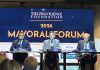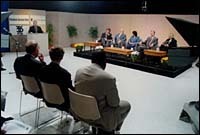
forum at Channel 36 studio.
(Brian McDonald)
Is there a vision in place — a blueprint, so to speak — for long-term prosperity in Rhode Island?
The answer from a mix of leaders from Rhode Island’s business, education and arts communities brought together by the Providence Business News, is yes. And in fact, there are many visions. But whether the tools are in place — whether the resources, leadership and cooperative support exist — to turn even the most sound blueprint into reality — was the subject of a lively discussion last Thursday night (May 24) on WSBE Channel 36.
Seifert Systems Invests in Energy Efficiency to Strengthen Operations
For manufacturers, energy is more than just another operating expense. It plays a critical role…
Learn More
The discussion served as the focus of the “Rhode Island Summit: Business Vision for Rhode Island,” hosted by the Providence Business News and broadcast live. Citizens Bank sponsored the event.
The panel was composed of Leonard Lardaro, professor of economics at the University of Rhode Island; Donna Cupelo, president of Verizon-Rhode Island; Diana Lam, Providence School Superintendent; Gary S. Ezovski, president of Lincoln Environmental and Oskar Eustis, artistic director at Trinity Rep.
Lardaro cautioned that Rhode Island is missing the opportunity presented by the Information Age.
“The Information Age is not an obstacle, it is an opportunity,” he said.
Lam reminded panelists and the audience that no long-term prosperity could be counted upon unless the entire community – including both public and private sectors – commits deeply to educating and properly training its young people.
“I am going to choose right now to see the glass as half-full,” said Lam. “But unless we are supported to the level that we need in education, we will lose any momentum we have built. You can walk into any elementary school in the city and see a difference – a marked difference. But we have to be compensated for the neglect of our schools over a long period of time.”
Cupelo said the state is full of great ideas, and that it is time to lay a path for getting them accomplished.
Ezovski said he prefers to see the glass as “at least half-full,” as opposed to being half-empty. Where he sees a challenge, he said, is in brining together ideas that often become fractured by the weight of competing interests.
Eustis, an artist at heart and by profession, was not at all out of place in discussing a business vision – a better economy.
He reminded everyone that dreams do come true when people work hard to make them happen.
“There are all sorts of unlikely things that can happen when you believe in them,” he said.
Eustis noted that Trinity Rep is playing to an audience this year that has doubled in size from its audience of five years ago — so much for a slowing economy. Eustis also boldly predicted that within 10 years, Providence would emerge as an arts Mecca.
“I believe that Providence will become recognized as a center of arts, arts training and the creation of new and experimental work – a broad-based theater and arts community that is unlike any other in the country,” he said. “Already we have a national reputation. But we have the ability to cement that reputation by becoming an absolute Mecca for arts in the United States. And I can’t help but believe that will have a positive impact on the economy of the state.”
Education the key
If one theme rose to the forefront at the summit it was the importance of education to the state’s economy. And while Lam obviously championed that opinion, she did not to wait long for her fellow panelists to support her position.
“Without a good education system the business community can have all the vision it wants to have, but,” said Lam.
Lam spoke of the importance not only of internship programs, but more importantly of internship programs that are taken seriously, coordinated closely by both sides and seen through to completion.
“Everyone now is talking about project-based learning – about transferring skills to the workplace,” she said. “But student internships are doomed to fail if they aren’t done well.”
Ezovski said there is clearly a role in education for the business community.
“Education is the key to our economic future,” he said. “I think we can help to bring excitement to education.”
Lardaro criticized state government for taking millions of dollars of savings resulting from the early payment of our DEPCO debt and putting it into the state’s general fund, rather than earmarking it specifically for education. Now is the time, he said, to invest more deeply in education to make it “recession proof.”
Cupelo would like to see clearer plans for how the business community can help in education. The desire and commitment on behalf of the business community, she said, clearly exists.
“The business community is constantly trying to articulate what is its role in education,” said Cupelo.
Eustis agreed.
“There is more we can do – more we want to do to help the education system,” he said. “Sometimes we’re not sure what to do.”
Deep rooted parochialism
Defining what can be done – how best to use the talents of the business, education and arts communities in Rhode Island – would go a long way toward making progress in transforming a vision into reality. Eustis, for one, would like some direction as to how he can do more.
“I know how to make things happen at my theater,” he said. “I know how to be an active participant within the arts community. But I am frustrated once we get outside of the areas of my expertise, but where I still care – education, urban development, and the downtown. There, I don’t know where to put my personal resources and where to put the resources of my institution so that they will do the most good.”
It is also clear, at least in the eyes of these panel members, that Rhode Island would benefit from being a bit less parochial.
Ezovski sees the parochialism – particularly in how Rhode Islanders approach travel. It has been fodder for humor for years, but it’s not really funny.
“Not so long ago, you didn’t travel from Lincoln to Providence,” he said. “In other states, they were traveling these distances long before we were.”
Lardaro sees it in a myopic way of thinking all too prevalent in the state.
“We often compare ourselves only to ourselves and not the rest of the country and the rest of the world like we need to,” he said. “We only look at the here and now and our legislation often reflects that. We treat symptoms, but not problems.”
But Lardaro also comes back to the opportunities presented by the Information Age. He expounds the idea that much remains possible. And there is precedence for accomplishment.
“I think the financial services legislation was probably the best example of what we can do,” he said. “We comprehensivey analyzed something, we found a niche and we went after it. We did it all right.”
Eustis sees the success of his theater and holds it up as another example of what can be done. And maybe Rhode Island’s size makes such success even more possible.
“Surely it is possible to mobilize our resources to make great things happen,” said Eustis.
Lardaro believes the time to act is now. “Rhode Island needs a dominant niche that a lot of things could fit into,” he said. “We need a master plan. If we stay the course, gradually things will happen. But do we want to wait for gradually?”